Touring golf courses in the Northeast has been a great pleasure for me this Fall. There are literally dozens of seriously great golf courses all within 1-3 hours drive (depending on traffic) of NYC alone. A truly unmatched stock of golden age golf. Since starting work on Paramount's (A.W. Tillinghast) restoration I have been able to see Sleepy Hollow (C.B. Macdonald), St. George's (Devereux Emmet), and Whippoorwill CC (Charles Banks), all built in the early 20th century. Touring these courses in addition to an intensive study of Paramount has allowed me to think critically about how the architecture of this period was influenced not only by the technological limitations of the time but also the way that golf was played.
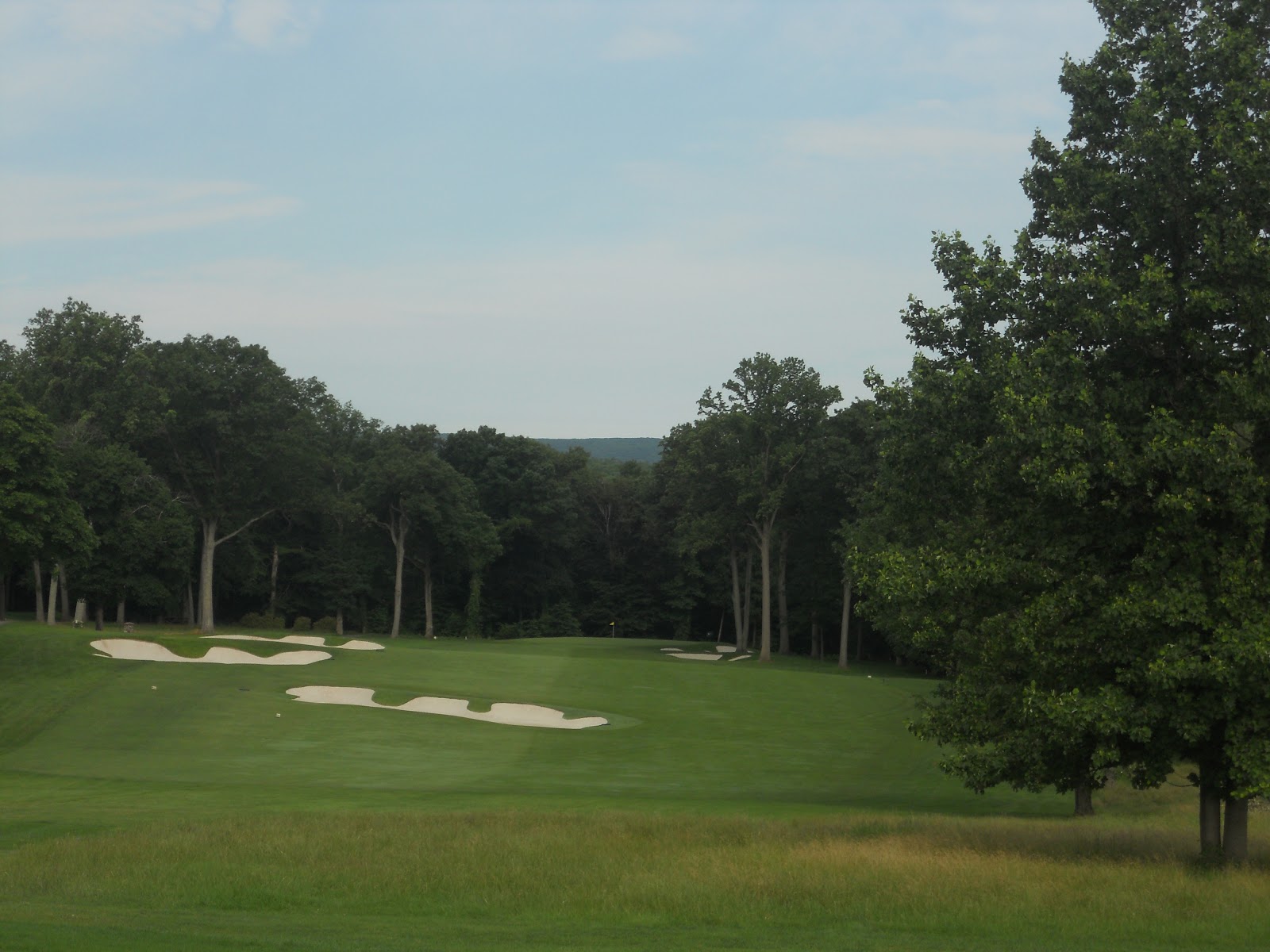
During my recent visit to St. George's in Stony Brook, Long Island I was struck in particular by the green complex of the short par four, 4th hole. Guarding the front of the green and hidden from view is a massive pit filled on the bottom with sand. I could not tell the bunker was there until I very nearly walked into it upon approaching the green. After playing my ball out of that sandy cavern (and taking bogey) I began to think how this feature fit into the overall scheme of the design. Upon observing the surrounding landscape and playing the next few holes I came to the conclusion that the bunker was not necessarily apart of any grand scheme in the design but merely a function of the need to see the target. The property is quite abrupt and hilly, in particular where the end of the 4th hole came to be. By digging a massive 10 foot pit, Emmet and Co. were able to use that material to prop up the surface of the green so that it could be viewed from the fairway. In this case it seemed apparent that the form of the green was vastly a necessity of its function, to see the target.
By creating a bunker feature, Emmet was able to get the most out of his green site, which would be otherwise out of view, fitting it into the rest of the routing. Also to consider, in the absence of ideal ground conditions (ie. sandy soils) and heavy machinery the "push-up" style of green construction was the easiest and most effective method. By flopping the soil behind the pit and forming a raised platform, the putting green could easily shed water and the ensuing bunkers could be used to add strategic and visual interest around the green, both a positive consequence of function influencing form.
I believe that many of the golf courses built before the advent of the steam shovel, aka bull dozer,(with the exception of a few modern design) are as close to equating form and function than at any other time in golf construction. Some today would call Emmet's building style at St.George's minimalism, I say this is the logical practice of golf course construction.
Sunday, November 6, 2011
Paramount Country Club-- A Restoration..
![]() |
| #1 Green atop the hill |
My latest project has taken me back home, as luck would have it, only 30 minutes drive from a free meal at my parents house! I will be helping to restore the little known, yet impressive, Paramount Country Club in New City, NY. An A.W. Tillinghast design (1921), the golf course is part of the former estate of Adolph Zukor, movie mogul and founder of Paramount Pictures. Golf holes here rise and fall over very hilly terrain on the front nine and follow some more interesting fairway contours on the back nine as well. Many of the greens pitch steeply from back to front, a typical feature of many classically designed golf courses. Over the next two Fall seasons, Paramount Country Club will be receiving its due justice under the guidance of architect Jim Urbina and superintendant Brian Chapin. The scope of the restoration, outlined in Urbina's master plan, embraces the inherent history of early 20th century golf architecture, restoring original bunkering schemes and shapes and sizes of the greens. Paramount is a golf course with great bones in good hands, it will surely make a lasting impression.
![]() |
#5 Featuring newly restored fairway bunkers
|
Tuesday, October 25, 2011
37 Days at the Dismal River Golf Club
| The Dismal River pictured with 13,15, and 16 greens |
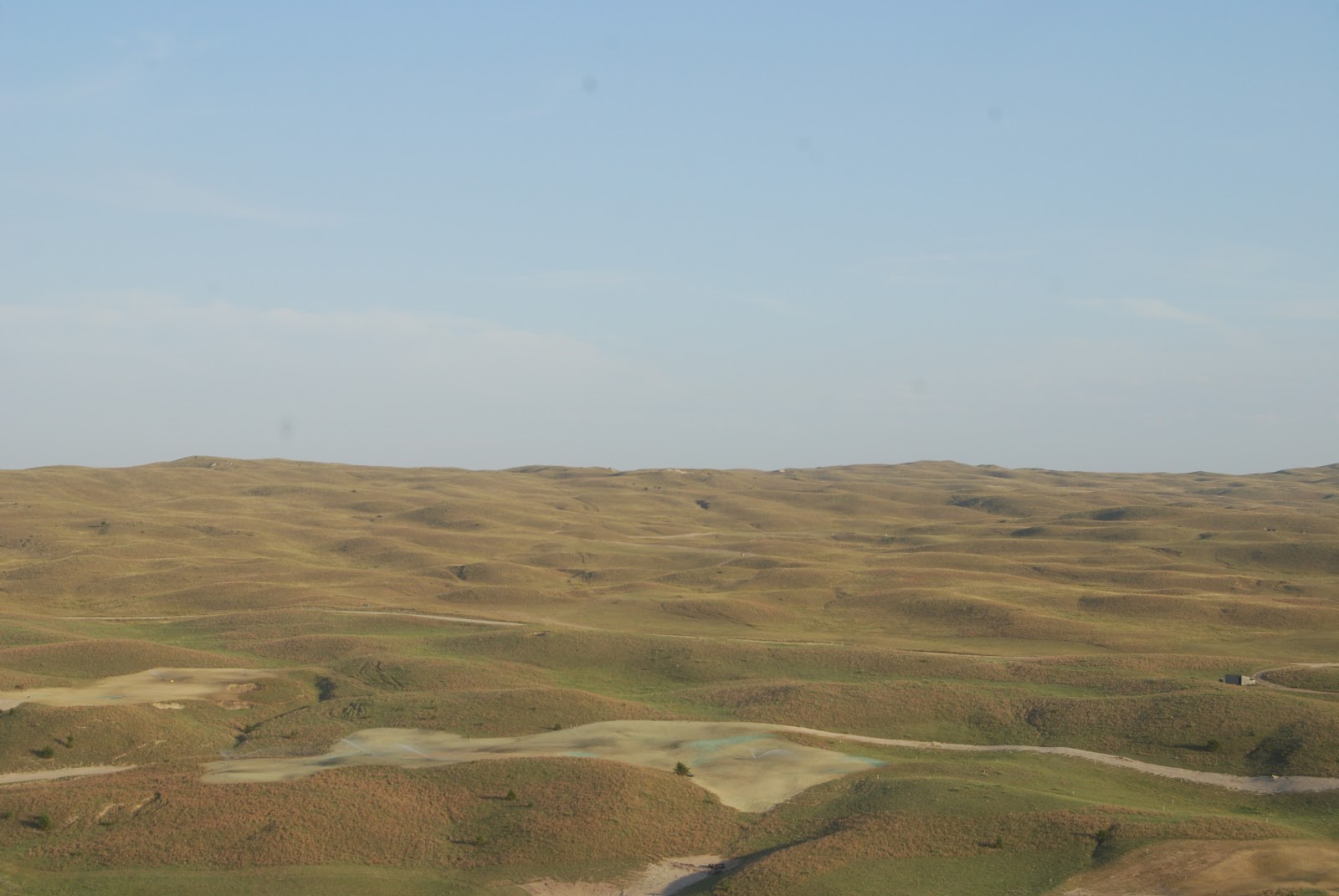
| Spacious Nebraska sand hills |
Chasing work around the world has its benefits, but I really can't say with much certainty where I'll be working six months from now...At the beginning of this summer I thought it might be a good idea to take online courses for a degree in turfgrass management (it still might be) until I got the word that I would be travelling home to New York for a restoration project with Jim Urbina. All the while I am receiving e-mails about working in China, Scotland, and then out of nowhere, Nebraska!
I travel light and am usually available to work in a matter of 1-3 weeks, easily able to get on a plane to China or Australia and work there for a month or two. This is exactly what happened at the beginning of August 2011. I exchanged e-mails and phone calls with Renaissance Golf Design in regard to their latest project in the Sand Hills of Nebraska, one of America’s treasured golf lands. I couldn’t resist the offer, the project promised to be great along with a chance to sharpen my skills for my upcoming work in NY.
| 10 and 11 Green viewed from atop "little horseshoe" |
The first week we all began to get our feet wet, mowing down fairways and areas to be disturbed but the true golfing landscape quickly unfolded before our eyes. The property at Dismal River is amazingly fit for golf with many natural green sites and naturall hazards, there is no way this could have been created by man. Architect Tom Doak simply blazed a path to a golf course that was always there.
Friday, October 7, 2011
The Logo Says it All
| Silvery Phacelia (Phacelia Argenta) |
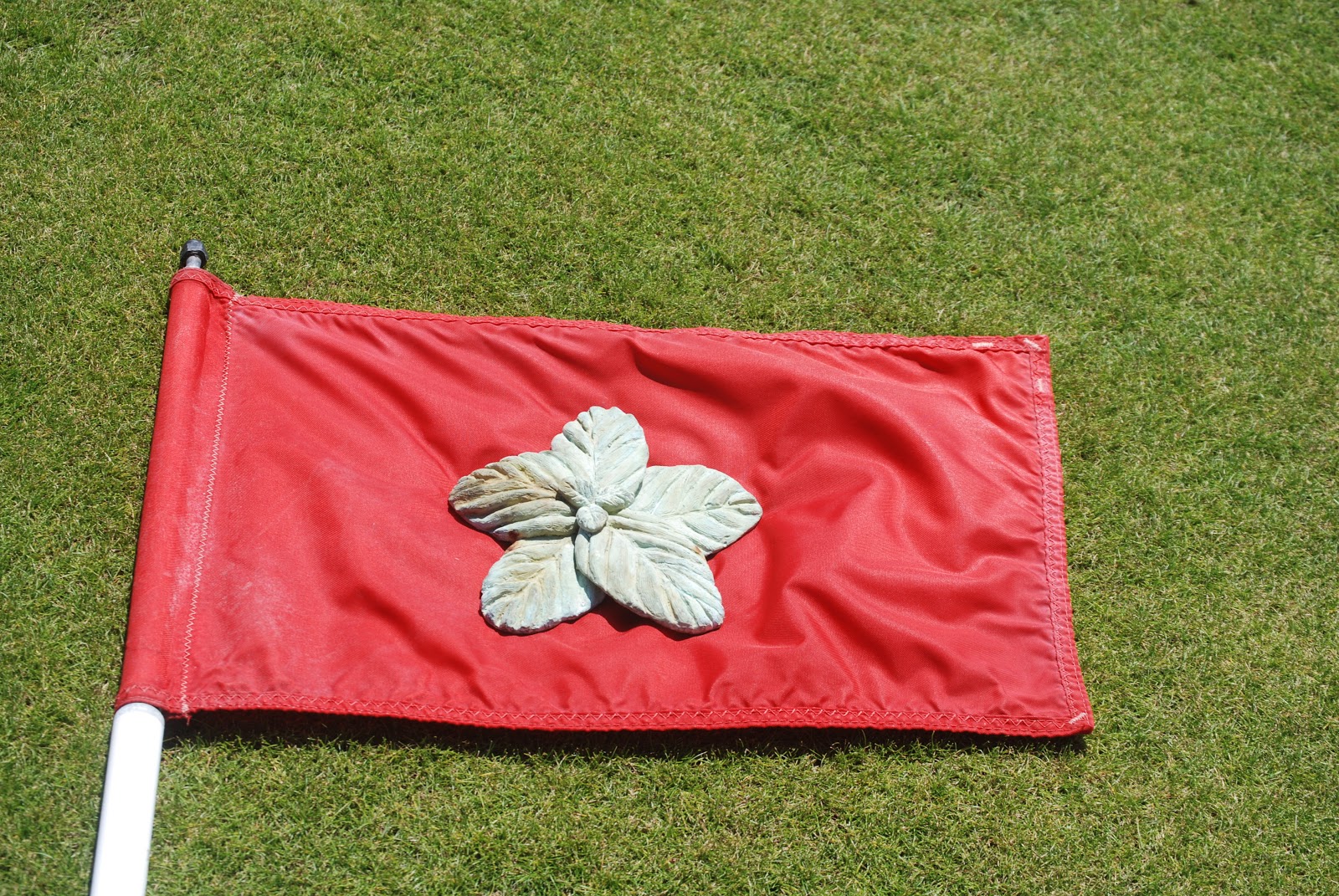
While working closely with the local fauna on the Bandon Preserve I got it in my head that the silvery phacelia plant would be the perfect place to start a logo concept. The silvery phacelia is a rare dune plant which thrives in the open sand dunes of Oregon’s south coast. Its largest known population exists on the Southern tip of the Bandon Dunes Golf Resort (follow the link to learn more about the conservation effort of the silvery phacelia plant at the Bandon Dunes Golf Resort, Takin' it All In by Jeff Stein).
In order to bring my idea to fruit I decided to enroll myself in a bronze casting class at South West Oregon Community College, Coos Bay, Oregon. I spent two nights a week for two months developing the logo through its many and varied stages of production, not a simple task.
I started with a carefully molded wax model and was able to reproduce my design five times from a "mother mold" that I created from the original. The bronzing process was a success, but much more painstaking than I anticipated. Each of the five silvery phacelia statues, in addition to ten smaller single bronze leafs, required hours of finish grinding and sanding because of the imperfect process that is bronze casting. In an attmept to put together the killer marketing package I created a graphic design of the stautes that I hope with make it as the offical logo of the Bandon Preserve.
I am obviously proud to have taken an idea born of my own physical work and then to create an object that holds space with weight and texture, it is extremely satisfying. The last step to unify the idea in my head was a marketable graphic that could be printed, embroidered, or stamped. The graphic design process was something even more foreign to me. For this I hired an extremely talented artist, Jon Snider of Goodspeed Graphics. We corresponded through e-mails and pictures of my bronze statues. From our distant communication we were able to come up with a pretty good preliminary design that I hope will please those in marketing at the Bandon Dunes Golf Resort.
![]() |
| Preliminary Logo |
I have relished the opportunity to fully immerese myself in all aspects of the Bandon Preserve project. Through my experiences working on the golf course I received a first class education from Bill Coore and design associate Dave Zinkand. At the same time I learned about development, project management, maintanence practices, and marketing. Its been one of my best learning experiences so far on the job and I can't wait to begin my next project.
Subscribe to:
Posts (Atom)